

Hey there! As an AC servo motor supplier, I've been getting a lot of questions about the commutation method of AC servo motors. So, I thought I'd write this blog to break it down for you in a simple and easy - to - understand way.
First off, let's talk about what commutation is. In an AC servo motor, commutation is the process of switching the current in the motor's windings at the right time. This is super important because it makes sure the motor rotates smoothly and efficiently. You can think of it like the gears in a car. If the gears don't shift at the right time, the car won't run properly. Similarly, if the commutation in an AC servo motor isn't done right, the motor won't perform as it should.
There are mainly two types of commutation methods for AC servo motors: sensor - based commutation and sensorless commutation.
Sensor - Based Commutation
Sensor - based commutation uses sensors to figure out the position of the motor's rotor. The most common sensors used are Hall - effect sensors and encoders.
Hall - Effect Sensors
Hall - effect sensors are pretty cool. They work by detecting changes in the magnetic field around the rotor. When the rotor moves, the magnetic field changes, and the Hall - effect sensors can sense these changes. Based on the signals from these sensors, the motor controller can determine the rotor's position and then switch the current in the windings accordingly.
The advantage of using Hall - effect sensors is that they're relatively inexpensive and easy to install. They're also quite reliable. However, they have some limitations. For example, they can only provide a limited amount of position information. So, they're usually used in applications where high - precision positioning isn't required.
Encoders
Encoders, on the other hand, are more accurate than Hall - effect sensors. There are two main types of encoders: incremental encoders and absolute encoders.
Incremental encoders generate a series of pulses as the rotor rotates. By counting these pulses, the motor controller can calculate how far the rotor has turned. But the problem is, when the power is turned off and then back on, the controller loses track of the rotor's absolute position.
Absolute encoders, on the other hand, can provide the exact position of the rotor at any given time. They're more expensive than incremental encoders, but they're worth it in applications where high - precision positioning is crucial, like in CNC machines or robotics.
Sensorless Commutation
Sensorless commutation, as the name suggests, doesn't use any physical sensors to determine the rotor's position. Instead, it relies on the electrical characteristics of the motor, like the back - EMF (electromotive force).
When the rotor rotates in the motor, it generates a back - EMF in the windings. By measuring this back - EMF, the motor controller can estimate the rotor's position. This method has some big advantages. For one, it reduces the cost of the motor because you don't need to buy and install sensors. It also makes the motor more reliable since there are fewer components that can fail.
However, sensorless commutation isn't perfect. It can be a bit tricky to implement, especially at low speeds when the back - EMF is very small and hard to measure accurately. Also, it might not be as precise as sensor - based commutation in some high - precision applications.
Now, let's talk about how these commutation methods affect the performance of different types of our AC servo motors.
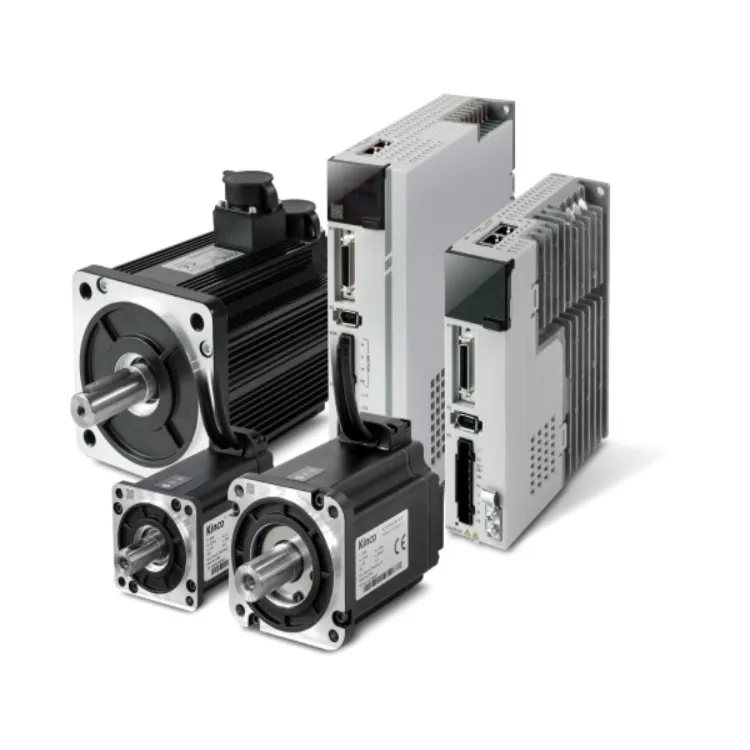
We offer a wide range of AC servo motors, including the 750w Servo Motor and the 1.5Kw Servo Motor. For the 750w servo motor, if you're using it in an application where you need moderate precision, like in a small conveyor system, a Hall - effect sensor - based commutation might be a good choice. It's cost - effective and can get the job done.
But if you're using the 1.5Kw servo motor in a more demanding application, like a large - scale industrial robot, you might want to go for an encoder - based commutation, preferably an absolute encoder. This will ensure that the motor can move with high precision and repeatability.
We also have the Single Phase AC Servo Motor. These motors are often used in smaller, less - complex applications. For these motors, sensorless commutation can be a great option. It keeps the cost down and still provides decent performance.
In conclusion, choosing the right commutation method for your AC servo motor depends on your specific application requirements. If you need high precision, you might want to go for sensor - based commutation with an encoder. If cost is a major concern and you don't need extremely high precision, sensorless commutation or Hall - effect sensor - based commutation could be the way to go.
If you're in the market for an AC servo motor and are not sure which commutation method is right for you, or if you have any other questions about our products, don't hesitate to reach out. We're here to help you make the best choice for your needs. Whether you're a small business owner looking for a single motor or a large - scale manufacturer in need of bulk orders, we've got you covered. Let's have a chat and see how we can work together to meet your motor requirements.
References
- "Electric Motors and Drives: Fundamentals, Types and Applications" by Austin Hughes and Bill Drury.
- "Power Electronics: Converters, Applications, and Design" by Ned Mohan, Tore M. Undeland, and William P. Robbins.