
Hey there! As a supplier of DC servo drivers, I'm super stoked to dive into how these nifty devices achieve closed-loop control. It's a topic that's not only fascinating but also crucial for anyone looking to understand the ins and outs of motion control systems.
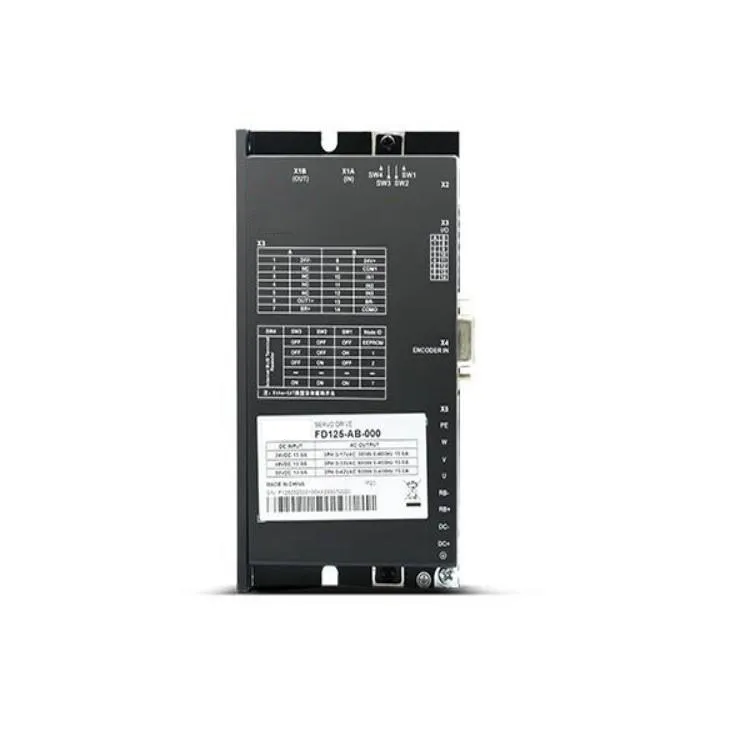
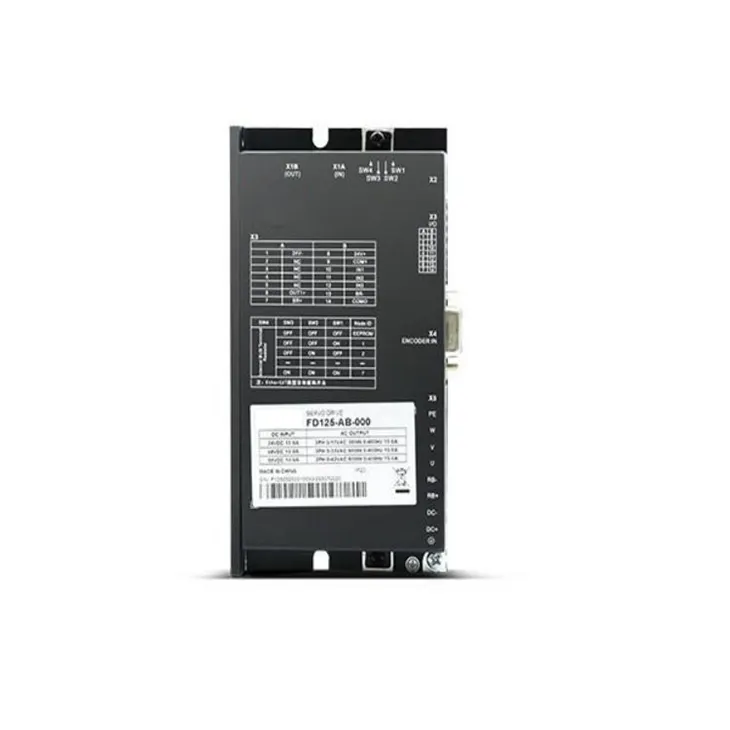
Let's start with the basics. A DC servo driver is like the brain behind a DC servo motor. Its main job is to regulate the motor's speed, torque, and position accurately. Closed-loop control is the secret sauce that makes this possible. In simple terms, closed-loop control means that the driver constantly monitors the motor's actual performance and compares it to the desired performance. Based on this comparison, it makes adjustments to ensure that the motor behaves exactly as it should.
So, how does it all work? Well, it all starts with sensors. Most DC servo drivers use sensors like encoders or resolvers to measure the motor's position, speed, and sometimes even torque. These sensors send real-time feedback to the driver, which then uses this information to make decisions.
Let's take a closer look at the position control aspect. Suppose you want the motor to rotate to a specific angle. You'd send a command to the DC servo driver, telling it the desired position. The driver then checks the feedback from the position sensor to see where the motor currently is. If the motor is not at the desired position, the driver calculates the error – the difference between the desired position and the actual position.
Once the error is calculated, the driver uses a control algorithm to determine how much power needs to be sent to the motor to correct the error. This algorithm is usually a proportional-integral-derivative (PID) controller, which is a widely used method for closed-loop control. The PID controller takes into account the current error, the accumulated error over time (integral), and the rate of change of the error (derivative) to calculate the appropriate control signal.
The control signal is then used to adjust the voltage or current supplied to the motor. If the motor is lagging behind the desired position, the driver will increase the power to the motor to speed it up. Conversely, if the motor is ahead of the desired position, the driver will reduce the power to slow it down. This continuous process of monitoring, comparing, and adjusting ensures that the motor reaches and maintains the desired position accurately.
Speed control works in a similar way. You set a desired speed for the motor, and the driver uses the speed feedback from the sensor to calculate the error. The PID controller then adjusts the power to the motor to keep the speed as close to the desired value as possible.
Torque control is a bit more complex, but the basic principle remains the same. Torque is the rotational force produced by the motor, and in some applications, it's important to control the torque precisely. The driver uses a torque sensor to measure the actual torque output of the motor and compares it to the desired torque. The PID controller then adjusts the power to the motor to achieve the desired torque.
Now, let's talk about the benefits of closed-loop control in DC servo drivers. One of the biggest advantages is accuracy. With closed-loop control, the motor can achieve extremely high levels of precision in terms of position, speed, and torque. This is crucial in applications like robotics, CNC machines, and automation systems, where even the slightest error can lead to significant problems.
Another benefit is stability. Closed-loop control helps to maintain a stable operation of the motor, even when there are external disturbances or changes in the load. For example, if the load on the motor suddenly increases, the driver can quickly adjust the power to the motor to keep the speed and position constant.
Closed-loop control also improves the overall performance of the system. It allows for faster response times, smoother operation, and better energy efficiency. By constantly adjusting the power to the motor based on the actual performance, the driver can ensure that the motor operates at its optimal level, reducing energy consumption and wear and tear.
As a DC servo driver supplier, we offer a wide range of products to meet different needs. For those looking for a Low-voltage Servo Motor, we have a great selection that provides high performance in low-voltage applications. Our Integrated Servo Wheel is a compact and efficient solution for applications where space is limited. And if you need a small and lightweight driver, our Mini DC Servo Driver is the perfect choice.
If you're in the market for a DC servo driver or have any questions about closed-loop control or our products, don't hesitate to reach out. We're here to help you find the right solution for your application. Whether you're a small business looking to automate a process or a large corporation in need of high-performance motion control systems, we've got you covered.
In conclusion, closed-loop control is a fundamental concept in DC servo drivers that enables accurate, stable, and efficient operation of DC servo motors. By using sensors, control algorithms, and continuous feedback, these drivers can ensure that the motor performs exactly as required, even in challenging conditions. So, if you're looking for a reliable and high-performance DC servo driver, give us a shout, and let's start a conversation about how we can help you achieve your goals.
References
- Dorf, R. C., & Bishop, R. H. (2016). Modern Control Systems. Pearson.
- Franklin, G. F., Powell, J. D., & Emami-Naeini, A. (2015). Feedback Control of Dynamic Systems. Pearson.