
In the complex landscape of industrial automation, Programmable Logic Controllers (PLCs) play a pivotal role in controlling and monitoring various processes. Among the different communication buses used in PLC networks, the Controller Area Network (CAN) Bus has gained significant popularity due to its robustness, reliability, and high - performance characteristics. As a CAN Bus PLC supplier, I often encounter questions from customers regarding the maximum communication distance of CAN Bus in a PLC network. In this blog, I will delve into this topic, exploring the factors that influence the communication distance and providing insights into achieving optimal performance.
Understanding CAN Bus in PLC Networks
CAN Bus is a serial communication protocol that was originally developed for the automotive industry but has since found widespread use in industrial automation, aerospace, and other fields. In a PLC network, CAN Bus allows multiple devices to communicate with each other in a multi - master or multi - slave configuration. It uses a differential signaling technique, which means that data is transmitted as the difference in voltage between two wires (CAN_H and CAN_L). This differential signaling provides excellent noise immunity, making CAN Bus suitable for harsh industrial environments.
Factors Affecting the Maximum Communication Distance of CAN Bus
Several factors influence the maximum communication distance of CAN Bus in a PLC network. These factors include the bit rate, cable type, termination, and the presence of electromagnetic interference (EMI).
Bit Rate
The bit rate is one of the most critical factors affecting the communication distance of CAN Bus. In general, the higher the bit rate, the shorter the communication distance. This is because at higher bit rates, the signal has less time to travel along the cable before it starts to degrade. For example, at a bit rate of 1 Mbps, the maximum communication distance is typically around 40 meters. However, if the bit rate is reduced to 10 kbps, the communication distance can be extended up to 10 kilometers.
Cable Type
The type of cable used in the CAN Bus network also has a significant impact on the communication distance. Twisted - pair cables are commonly used in CAN Bus networks because they provide good electromagnetic shielding and reduce the effects of EMI. The quality of the cable, including its impedance, capacitance, and attenuation, can affect the signal integrity and, therefore, the communication distance. High - quality cables with low attenuation are recommended for longer communication distances.
Termination
Proper termination is essential for ensuring reliable communication in a CAN Bus network. CAN Bus requires a termination resistor at each end of the bus to prevent signal reflections. The value of the termination resistor is typically 120 ohms, which matches the characteristic impedance of the cable. If the termination is not correct, signal reflections can occur, leading to data errors and reduced communication distance.
Electromagnetic Interference (EMI)
EMI can have a detrimental effect on the communication distance of CAN Bus. In industrial environments, there are many sources of EMI, such as motors, generators, and power lines. To minimize the effects of EMI, it is important to use shielded cables and proper grounding techniques. Additionally, the CAN Bus transceiver should have good EMI immunity to ensure reliable communication.
Calculating the Maximum Communication Distance
The maximum communication distance of CAN Bus can be estimated using the following formula:
[d=\frac{k}{R}]
where (d) is the communication distance in meters, (R) is the bit rate in bits per second, and (k) is a constant that depends on the cable type and other factors. For a typical twisted - pair cable, the value of (k) is approximately (40\times10^{6}).
For example, if the bit rate is 500 kbps, the maximum communication distance can be calculated as follows:
[d=\frac{40\times10^{6}}{500\times10^{3}} = 80\space meters]
It is important to note that this is only an estimate, and the actual communication distance may vary depending on the specific conditions of the network.
Achieving Longer Communication Distances
To achieve longer communication distances in a CAN Bus PLC network, several strategies can be employed.
Reducing the Bit Rate
As mentioned earlier, reducing the bit rate can significantly increase the communication distance. However, this also means that the data transfer speed will be slower. Therefore, a balance needs to be struck between the communication distance and the data transfer speed based on the requirements of the application.
Using Repeaters
Repeaters can be used to extend the communication distance of CAN Bus. A repeater is a device that receives the CAN Bus signal, amplifies it, and re - transmits it. By using repeaters at regular intervals along the bus, the signal can be maintained over longer distances.
Improving Cable Quality
Using high - quality cables with low attenuation and good shielding can improve the signal integrity and, therefore, the communication distance. Additionally, proper cable installation, such as avoiding sharp bends and keeping the cable away from sources of EMI, is also important.
Comparison with Other Communication Buses
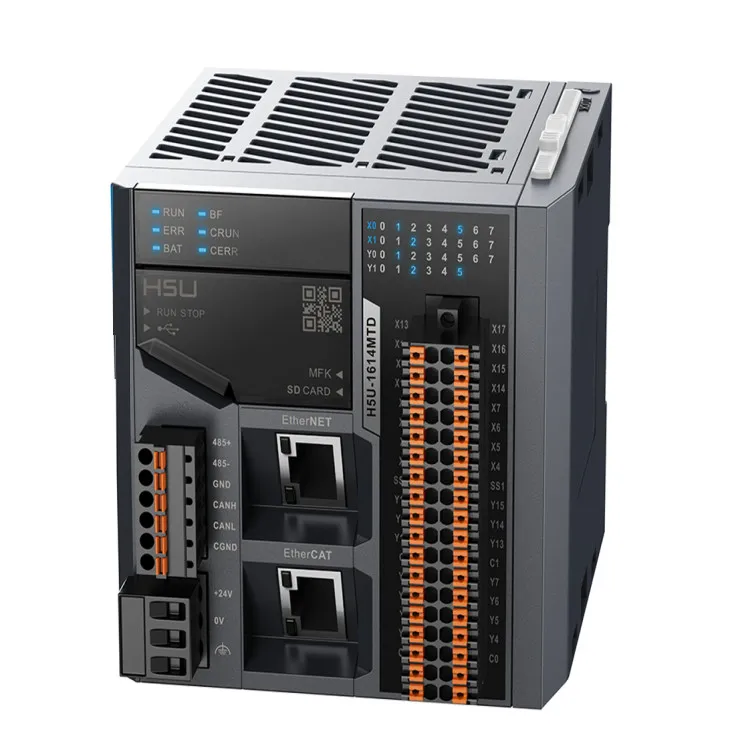
In addition to CAN Bus, there are other communication buses used in PLC networks, such as EtherCAT Bus PLC and 485 Pulse PLC. Each bus has its own advantages and disadvantages in terms of communication distance, bit rate, and cost.
EtherCAT Bus PLC offers high - speed communication with a relatively long communication distance. It is suitable for applications that require real - time data transfer and high - performance control. However, it is more complex and expensive compared to CAN Bus.
485 Pulse PLC is a simple and cost - effective communication bus that can be used for longer communication distances. However, it has a lower bit rate compared to CAN Bus and EtherCAT Bus, which may not be suitable for applications that require high - speed data transfer.
Conclusion
As a CAN Bus PLC supplier, I understand the importance of reliable communication in industrial automation. The maximum communication distance of CAN Bus in a PLC network is influenced by several factors, including the bit rate, cable type, termination, and EMI. By understanding these factors and implementing appropriate strategies, it is possible to achieve longer communication distances and ensure optimal performance of the CAN Bus network.
If you are considering using CAN Bus PLC in your industrial automation project and have questions about the communication distance or other aspects, I encourage you to contact us for a detailed discussion. Our team of experts can provide you with the best solutions based on your specific requirements. We look forward to the opportunity to work with you and contribute to the success of your project.
References
- Bosch, CAN Specification 2.0, Robert Bosch GmbH, 1991.
- ISO 11898 - 1:2015, Road vehicles - Controller area network (CAN) - Part 1: Data link layer and physical signalling.
- CAN in Automation (CiA), CANopen Specification, CiA e.V., 2002.